

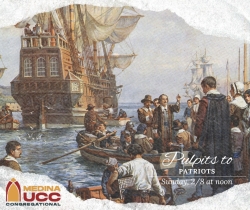
Pulpits to Patriots: How the Congregationalists helped shape America
February 9, 2026
- Rev. Dr. Luke Lindon
- Founders Day
- Identity and Purpose
- Politics
- Medina United Church of Christ Congregational
Given on 2/8/2026 as part of Medina’s America 250 Celebrations. Section on Connecticut added after great feedback from the community. That second is marked by the italics and not originally part of the lecture. You can listen to the audio version by clicking here.
I am the Rev. Dr. Luke Lindon, senior pastor for the past 8 years of Medina United Church of Christ, Congregational which has been welcoming, loving, and serving for 207 years here in Medina. You are in the second oldest church in our fair city. St. Paul’s Episcopal was the first. We worshipped with them in a log cabin way back 200 years ago. Interfaith and ecumenical matters have always been important to us.
My fellow Americans, I am going to talk to you today about our ancestor denomination, the feisty Congregationalists, and how they are a uniquely American story. It’s one that tells the story of our country. They have given us so many of our values. I would like to tell the story of how they went from pulpits to patriots.
Like most American stories, we begin somewhere else. Early 1600s. Scrooby, England which is about 150 miles north of London. A small group of religious radicals begins to meet. They want to return to the simplicity of the gospel. They want a church shaped by the Acts of the Apostles. Radical, after all, means returning to the roots, and that is exactly what they are trying to do.
They seek faithfulness to Christ as revealed in scripture, to be ruled by the witness of the Gospels rather than by tradition or man-made systems like royal bloodlines and hierarchies not grounded in the life of Jesus. They reject religious hierarchy, believing that people should covenant together in mutuality and equality. They believe there are no human mediators between God and God’s people. Each person has direct access to God. And they fear that the monarch’s demands threaten not only their earthly lives, but their eternal ones as well.
They try to reform the Church of England and fail. Folks are killed for this defiance, so they separate. This was illegal. English law required all worship to take place in sanctioned churches. Unsanctioned gatherings were forbidden. Attendance was mandatory, and failure to attend could cost you what amounts to thousands of dollars today. King James I was a law-and-order king, committed to religious conformity.
These Separatists, as they were called, begin meeting in secret. And in 1608, they leave England entirely, moving to Holland. They settle in Leiden, taking hard, grinding jobs in textile factories. They don’t know the language or the customs, but they are free to worship as they wish. Dutch society is relatively tolerant, but life is difficult, especially as an insular immigrant community. Economic hardship is constant. They also worry about their children becoming too Dutch. More than anything, they long for a place where they can form a community shaped entirely by their faith.
They can’t return to England. And in 1618, the Thirty Years’ War begins, raising new fears about political and religious instability. Eventually, they decide to risk the wilderness of the New World.
They commission two ships, the Mayflower and the Speedwell. The Speedwell proves unseaworthy, so everyone piles onto the aging Mayflower, a ship designed to haul wool and wine, not families.
One hundred and two people set out, bound for Virginia. About half are Separatists. Many others, including Pastor John Robinson, remain behind in Leiden. The rest of the passengers are sailors, laborers, and prospectors working for the company that financed the voyage, hoping to extract resources from the New World.
They get a late start. The journey is long and brutal. They land nearly 200 miles off course, in what is now Plymouth, Massachusetts. They are ill-equipped, underprepared, and by all accounts should not have survived. Of the eighteen married couples who begin the journey, only three remain intact after the first winter.
And yet something extraordinary happens.
Not only do they scrape by and survive in those first years, they do so under a new legal precedent. Before leaving the ship, they write the Mayflower Compact. It is not soaring poetry. It is simple and practical. It states that they will live together by covenant and consent. While many still profess loyalty to the monarch, in moments of crisis royal authority can be suspended. The authority of the majority cannot.
Local control is paramount. Nearly 90 percent of the adult men sign it, sowing the seeds of representative, local governance.
One of the signers is John Howland. He survives, marries, and with his wife has ten children and twenty-two grandchildren. Today, roughly two million Americans trace their ancestry back to him, including Ralph Waldo Emerson, Presidents Theodore and Franklin Roosevelt, Humphrey Bogart, and Presidents George H. W. and George W. Bush.
Most of what we think we know about the Pilgrims, the Ship, the Rock, and the Feast, was mythologized during the Civil War. William Bradford’s history was rediscovered after being lost for decades, sparking a Pilgrim revival in the late 1850s. Abraham Lincoln established Thanksgiving as a national holiday in the midst of the war. This narrative emphasized Plymouth, covenant, and consent of the governed, rather than Jamestown and its dependence on enslaved labor. Ironically, Bradford’s history never mentions Thanksgiving. The account comes from a paragraph by Edward Winslow, who briefly notes that Massasoit and ninety Wampanoag men joined the settlers for a harvest celebration. A humble moment, later enlarged by history. Once again to show that America’s roots are in the north and not the slave-holding south.
Squanto, or Tisquantum, famously aids the Pilgrims. He belongs to a people devastated by disease and threatened by rival tribes. The treaty between Plymouth and the Wampanoag is strategic. Massasoit seeks allies, and that peace lasts nearly fifty years. The settlers even nurse Chief Massasoit back to health when he falls ill. He later warns them of a planned attack. The response is brutal. The settlers strike first, displaying the severed head of a rival leader in Plymouth for years. To the Wampanoag, this demonstrates strength and commitment to the alliance. But from Leiden, Pastor John Robinson writes, “Where blood is shed, it is seldom staunched.” He is deeply disappointed.
The colony struggles financially. In 1626, investors declare bankruptcy. But a year later, beaver pelt prices soar due to the Thirty Years’ War, and Plymouth is saved. This success helps inspire a much larger colony: Boston.
A thousand new settlers arrive. These are not Separatists, but Puritans. They believe the Church of England can be purified through moral discipline and strict adherence to scripture. Over time, the original Separatists are absorbed into the growing towns.
Their ethos is similar: high piety, covenant, local control, and a strong Protestant work ethic. I believe we still see their influence today.
The Mayflower Compact echoes through American culture like a bell that never quite stops ringing. Town meetings. Local governance. Majority rule bound by shared responsibility. Authority rising from the people, not descending from a throne.
These were not perfect people. They made grave mistakes. They participated in violence. They benefited from systems that harmed Native peoples. We cannot tell their story honestly without telling the whole story. But we also cannot ignore what they contributed.
Congregationalists taught America how to argue together and stay together. How to bind freedom to responsibility. Their churches became schools for democracy long before democracy had a name here.
Later, their spiritual cousins spoke of being a “city on a hill.” Not as a boast, but as a warning. Live faithfully, because the world is watching. This rhetoric echoes through American politics, from John F. Kennedy to Ronald Reagan to John McCain in 2008.
We see the Puritan impulse when society limits what harms the common good. Growing up in the 90s, cigarettes were hotly debated and we saw the roll-back of smoking. Now when I tell my kids that we used to have smoking sections in restaurants, they think I’ve made it up. Or when I was new in ministry, there was a court case in New York state to limit the size of soda to 16 ounces because of the rise in obesity. Excessive sugar is bad for your health. So in Public health matters, sometimes the covenant outruns the autonomy. We also see the struggle with scapegoating, blaming outsiders when covenant fails. That impulse appears early, even among the Pilgrims. The desire to remove the heathen element was strong and often mentioned. We sadly see that on display today.
We see both failure and repentance in the Salem Witch Trials. Congregationalists were responsible largely. The trials happened in the township where the social media tools of the time: the village common, granges, and meeting halls were non-existent. This proves the danger of not having spaces like our Public Square here in Medina, and where distrust of our neighbors ultimately leads. Yet Judge Samuel Sewall publicly repented, standing in church as his confession was read aloud. He later authored the first anti-slavery tract in America, The Selling of Joseph. Our own H.G. Blake was a Congregationalist and conductor on the Underground Railroad. We see his work in helping to end the black laws, sort of a Jim Crow of the north, here in Ohio as his work as a representative.
Some Congregationalists owned slaves. Many were abolitionists. The only Founding Father who owned no slaves and has no monument in Washington, D.C. was a Congregationalist. Does anyone know who that is? John Adams.
Many Congregationalist pastors became Patriots. They were called the Black Robed Regiment. On April 19, 1775, the people of Lexington gathered on the green because they had been prepared. Their pastor, Jonas Clark, had taught them that authority exists for the common good, that conscience matters, and that obedience to injustice is not faithfulness. After the first shots, a British officer reportedly said of Clark, “This man is the fountain of the rebellion.” Clark carried no musket. He carried words. He educated his flock.
Congregationalists were obsessed with education. They founded Harvard, then Yale, two small liberal arts colleges on the east coast. After the Civil War, they founded historically Black colleges, including Howard University, named after a Union general and Congregationalist minister. They didn’t just preach liberty. They institutionalized it.
They were never perfect. There were struggles then, and there are struggles even now. But Congregationalist theology was never built on perfection. It was built on covenant. On a table where grace is shared, where sin is confessed, and where forgiveness makes room for tomorrow. Because of that, they learned how to muddle forward.
When they knew better, they did better.
The Congregationalists were the first Protestant denomination in America to ordain a Black man, Lemuel Haynes, in 1785. They ordained a woman, Antoinette Brown Blackwell, in 1853. And in 1972, they ordained an openly gay man, long before it was safe or popular. Each of those moments came with conflict. Each came with loss. Each came at a cost. And they paid it anyway.
Once, Congregationalists were among the strictest experiments in religion and government this country had ever seen. Mass. Bay Puritans outlawed Leap Frog. Not because it was ungodly or lewd or any concern like that. But because they couldn’t find it in the Bible. That’s how strict they were. But covenant has a way of stretching us. Over time, they learned that faithfulness does not mean freezing the past in place, but listening carefully as the Spirit keeps speaking. I joined the UCC in 2005 when they adopted the phrase, “God is still speaking.” I hear the echo of John Robinson’s words, “There is yet more truth and light to break forth from God’s Holy Word.” I now lovingly call the UCC the disorganized section of organized religion. Yet what is really true is that we’re still very strict on covenant and personal autonomy and being life-long learners open to the movement of God’s Spirit and loving our neighbor. And who is our neighbor? Everyone.
Congregationalists didn’t dominate American politics, but they trained America how to govern itself. They didn’t seek to control religious life either, because they take individual conscience seriously.
And yet they also knew this: when people choose community freely, when gifts are shared rather than hoarded, and when responsibility is embraced rather than imposed, good things happen. Yet they also show us an important learning we need to take heed. The issue with covenant is what happens when you just can’t agree? When terms cannot be set? This seems to lead to endless splintering that once started, cannot be stopped. The Congregationalists merged with the Christian denomination and then later the Evangelical and Reformed churches to make the United Church of Christ in 1957. Yet we also spawned the Unitarians in the 1700s as well as the Baptists? Which Baptists? All of them. It’s why we have Rhode Island as Massachusetts needed a place to dump all their heretics.
Massachusetts asked, “Are we a holy people?” They were very strict. Over time, they found themselves facing a generation worn down by that intensity, and they began trying to correct what they had created.
Thomas Hooker, in the founding of Connecticut, seemed to ask a different question: “How do we govern a godly people without breaking them?” That’s a powerful question.
We are part of the Western Reserve of Connecticut, and our founders were Connecticut Congregationalists. They tended to be more flexible, more pragmatic, less interested in enforcing purity and more focused on sustaining community.
As we struggle toward a more perfect union, I hope the Congregational Way still guides us toward the better angels of our nature. The Congregationalists remind us that America at its best is not held together by fear or domination, but by covenant. By people who choose one another. By neighbors who say, “We will do this together.”
That is not just our history. It is our calling.
Thank you for your time and the honor of contributing to the American 250 celebrations here in Medina, and from sea to shining sea.
Bibliography
Burns, Ric, dir. The Pilgrims. American Experience, PBS, 2020. Film.
Caldwell, Quinn, and Curtis J. Preston. The Unofficial Handbook of the United Church of Christ. Cleveland, OH: United Church Press, 2011.
Johnson, Daniel L., and Charles E. Hambrick-Stowe, eds. Theology and Identity: Traditions, Movements, and Polity in the United Church of Christ. Revised edition. Cleveland, OH: The Pilgrim Press, 2007.
“Jonas Clarke.” Wikipedia. Last modified February 2026. https://en.wikipedia.org/wiki/Jonas_Clarke (story original in my history and polity class)
Mauro, Rev. Dr. D. Elizabeth. The Art and Practice of the Congregational Way: A Church Guide. National Association of Congregational Christian Churches, 2021. PDF booklet, National Association of Congregational Christian Churches.
Starkey, Marion L. The Congregational Way: The Role of the Pilgrims and Their Heirs in Shaping America. Garden City, NY: Doubleday, 1966.
United Church of Christ. UCC Firsts. Accessed January 30, 2026. https://www.ucc.org/ucc-firsts/
Leave a Reply