

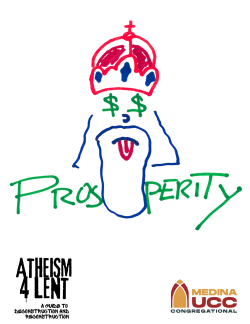
Prosperity
February 24, 2026
Once upon a time, a long time ago, in a land of sun and sand, there was a group of religious zealots.
They were so rigid that even people of their own faith couldn’t stand them. They were literalists. Loud. Certain. They preached purity and condemned anyone who didn’t practice religion exactly the way they did. Not just people of other faiths, but especially people of their own.
Over time, they came to see themselves as persecuted. Pushed to the margins. Out into the wilderness. They told the story this way: We are suffering because we are faithful. God is testing us.
And then history turned.
The land they controlled sat atop oceans of oil. Wealth poured in. Power followed. Suddenly, the story made sense. We were faithful. We endured. And now God has rewarded us.
That story still circulates today in the religious culture of Saudi Arabia, shaped by Wahhabism. A story that says obedience leads to blessing. Faithfulness produces wealth. Suffering is temporary, and prosperity is proof. It is a powerful story. It is also a dangerous one. I know another one like it.
Once upon a time, a long time ago, in another land far away, there was another group of religious zealots. They too were so strict that people of the same faith pushed them out. They crossed an ocean convinced they were God’s chosen, carrying a Bible in one hand and certainty in the other. They imagined themselves a new Israel, wandering into a new wilderness.
They suffered. They nearly starved. They told that story too: We are suffering because we are faithful. God is testing us.
And then history turned.
Trade flourished. Land expanded. The fur trade boomed. Towns became cities. What began as fragile settlements grew into places like Boston, shaped by Puritans and Pilgrims. And the story hardened: We endured. We obeyed. And God rewarded us.
This story didn’t stay in the 1600s. It became a national theology. A cultural instinct. A quiet assumption that says success means blessing, wealth means righteousness, and suffering must mean someone did something wrong.
We see this on the prosperity preachers who will pray for us for easy monthly installments of $29.99 on the back channels of our T.V. We see that this is profitable business. One such ministry preaches in a former basketball arena. Others fly jets around or drive expensive cars.
There is a Instagram I follow called PreachersNSneakers. It details the fashion choices of many celebrity preachers. One man recently preached on resisting the desires of the flesh in $900 Jordan 5 retro sneakers. Another man preached on the importance of the working man in a thousand dollar Carhartt dupe.
This sounds judgy doesn’t it. It could also sound biblical. Consider our two texts for this day. Job and Jesus.
Job explodes the idea that righteousness guarantees prosperity. God explicitly allows suffering without moral cause.
Job is the most faithful man in the whole world. Job doesn’t say this. God says this about Job. Yet ha-satan pipes up. It’s good to know that the word here isn’t a name, it’s more of a title. It is an ancient equivalent to “the prosecuting attorney.”
Heaven’s prosecutor pipes up and says, “Job only loves you because his life is good.”
“Wanna bet?” says God. And then the story is off and running.
Job loses everything. He loses his property, his children, and his health. He has boils and skin irritation. For a while, all he does is sit in dust and ash. He’s in mourning. His friends show up and the best thing they do is sit with him. Job then laments the day he was born. As a response, his friends ask, “Well, what did you do to bring this on yourself?” This spawns a 34 chapter argument. His friends ask this question in a variety of ways. Job proves his innocence.
This is part of the Bible in conversation with itself. Job is a counter to Deuteronomy. Deuteronomy promises that if you follow the law perfectly, then you’ll have health and wealth as a sign of the Lord’s favor.
It’s why many scholars call the bible “a text in travail.” It argues with itself. Deuteronomy is countered by Job. The account of David found in Samuel is sanitized by Chronicles.
Sometimes, bad things happen. Job complains that the wicked often go unpunished. This inspired the book “When Bad Things Happen to Good People” by Harold Kushner.
Jesus must have read that book. Well, Job at least as Jesus also counters the theology of Deuteronomy. He talks of how it rains on the wicked and righteous alike. When a tower falls and kills, a question of their sinfulness arises. Jesus dismisses it entirely.
In today’s scripture, Jesus is in the wilderness. This is our biblical basis for the season of Lent. There, Jesus rejects every temptation to prove divine favor through material security, spectacle, or power. Who is he tempted by? The prosecutor.
Jesus, the sinless. Jesus, the pioneer and perfector of our faith. Does he get health and wealth? No. He gets the cross. And yes, the resurrection. But to get to Easter Sunday, he has to go through the three days before. Betrayed, denied, and abandoned on Maundy Thursday. The mocking, the beating, and the torture of three hours on the cross. The silence of the tomb on Saturday. Even the resurrected Christ bears the scars.
There’s the rub for me for the whole prosperity gospel. Was Jesus rich? When asked about paying taxes, he has to ask for a coin. He didn’t seem to have one. Mark 2:1 mentions that Jesus was at home. Yet in the other gospels there’s no mention. He seems rather itinerant, saying in Matthew, “Foxes have dens to live in, and birds have nests, but the Son of Man has no place even to lay his head.”
Jesus told us not to worry about what we eat or what we wear. It was never once reported what he wore save for last Sunday’s text: his clothes were white in the transfiguration.
So here’s the truth we come to in the dust of Job and the wilderness of Jesus: faithfulness does not guarantee comfort. Righteousness does not promise wealth. Obedience does not come with a vending-machine blessing button.
Job sat in ashes. Jesus walked hungry through the wilderness. And yet—the story does not end in despair. It ends in God. It ends in presence, in purpose, in a love that does not calculate, that does not tally up the balance sheet, that refuses to measure worth by what we have or what we earn.
So forget the piles of cash. Forget the preacher’s jet. Forget the flashy sneakers and Instagram ministries. Those are not signs of God’s favor—they are signs of human vanity.
The real story is the one that never stops being told: the faithful endure, not because they are promised comfort, but because there is a God who walks through the ashes with them. The faithful endure, not because they will be rewarded, but because in their endurance, they meet the God who knows their suffering.
And if you believe that, then here’s what you do:
You live faithfully, even when the world tells you to chase the shiny, the easy, the profitable.
You love boldly, even when there’s no reward for it. Often, it’s the opposite. All 12 of the disciples were killed. There’s the long list of martyrs. Recently I saw a short video of a dad teaching his daughter about Jesus. How she was thrilled about his teachings. How she loved learning about all he did. Yet when she saw a crucifix, she asked who it was, he realized that he didn’t tell her the end. He told her how he died. He stood for love and they killed him for it.
A little while later, it’s Martin Luther King, Jr Day. The daughter asks her dad who that is. “It’s MLK. He was a preacher. He talked about Jesus. He stood for love.”
Her only question, “Oh. Did they do to him what they did to Jesus?”
The kingdom of God is not about wealth. It’s not about comfort. It’s not about avoiding the wilderness. The kingdom of God is about walking with God in the wilderness, sitting in the ashes, and knowing…truly knowing… that love, mercy, and faithfulness are worth more than gold, more than land, more than power.
True prosperity is not measured in bank accounts but relationships. In moments of awe and gratitude. So leave here today and live like Job. Walk like Jesus. Resist the temptation to measure God’s favor in dollars and possessions. Because the God who redeems the suffering, who fills the hungry, who walks with us in the wilderness. That God is already with you. And that is enough. Thanks be to God. Amen.
Leave a Reply